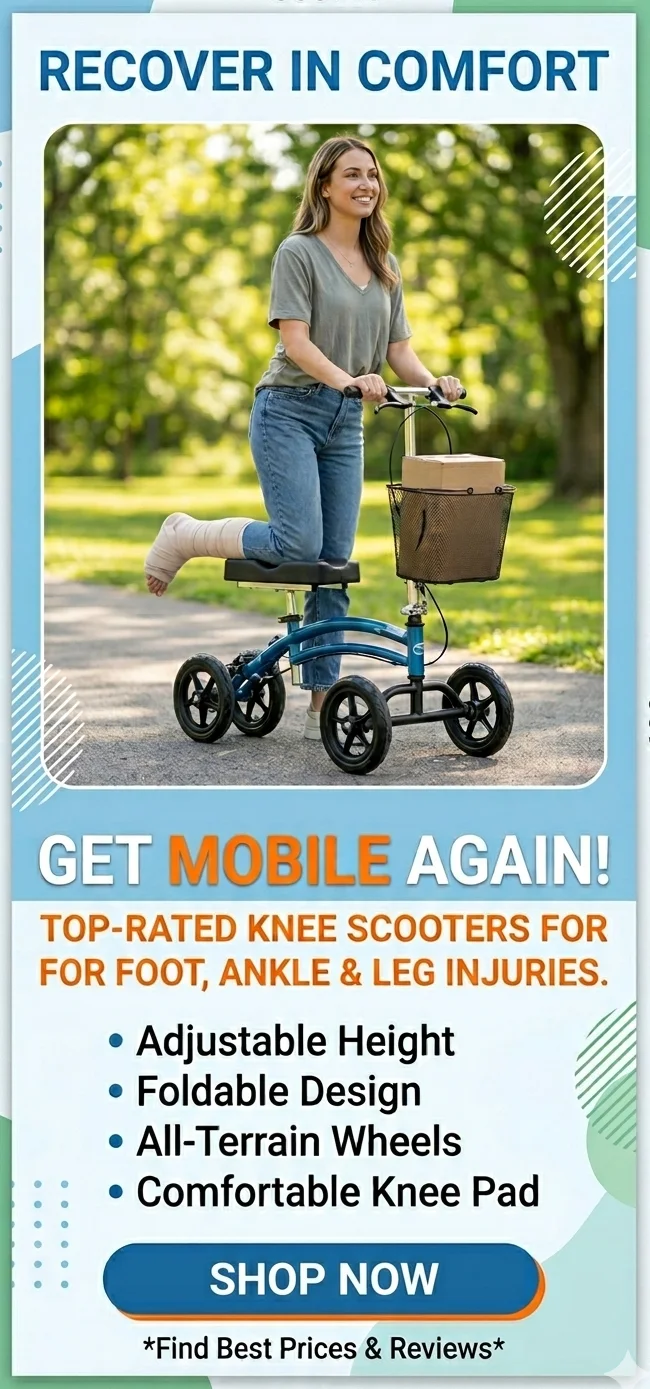
A knee scooter, also called a knee walker, can make daily life much easier when you need to keep weight off your foot, ankle, or lower leg. Compared to crutches, many people find a knee scooter more comfortable, easier to maneuver, and less tiring during recovery from surgery or injury. From compact folding models for travel to rugged all-terrain designs for outdoor use, today’s knee scooters come in several styles to fit different needs and lifestyles.
Why would someone need to use a knee scooter?
People often use a knee scooter when they need a non-weight-bearing or limited-weight-bearing mobility aid for recovery. This usually includes healing from foot or ankle surgery, fractures, sprains, Achilles injuries, or other lower leg conditions. A knee scooter can also be helpful for people who struggle with the upper-body strain that often comes with using crutches.
Common reasons people use a knee scooter:
- Foot or ankle surgery: Many recovery plans require keeping weight off the affected foot or ankle for days or weeks.
- Broken foot or ankle: A knee scooter can help you stay mobile while protecting the injured area.
- Sprains and soft tissue injuries: Some injuries need reduced pressure and controlled movement during healing.
- Achilles injuries: Recovery from Achilles tendon issues often limits normal walking.
- Diabetic foot concerns: In some cases, offloading pressure from the foot is important during healing.
- Difficulty using crutches: People with wrist, shoulder, or underarm discomfort may prefer the support of a knee scooter.
- Longer recovery periods: For multi-week recoveries, a knee scooter may be more practical for everyday use around the home, office, or outdoors.
What are the advantages of using a knee scooter over crutches?
For many users, a knee scooter offers a better overall experience than crutches. It can reduce upper-body fatigue, improve comfort, and make it easier to move through daily routines. While crutches are still useful in some situations, knee scooters are often preferred for flat surfaces and longer periods of movement.
Advantages of a knee scooter over crutches:
- More comfort: A padded knee platform can feel easier on the body than prolonged crutch use.
- Less upper-body strain: Crutches can be hard on the hands, wrists, shoulders, and underarms.
- Better everyday mobility: Many users can move faster and more smoothly on indoor flooring and sidewalks.
- Greater convenience: Some models include baskets or storage pouches for carrying small items.
- More independence: A knee scooter can make simple tasks like moving through the kitchen or workplace easier.
- Adjustable fit: Most models offer adjustable handlebars and knee pad heights.
- Travel-friendly options: Folding designs can be easier to store in a vehicle or closet.
- All-terrain availability: Larger wheel models can handle rougher outdoor surfaces better than standard indoor-style scooters.
Top Knee Scooter Questions Answered
Q: What is a knee scooter used for?
A: A knee scooter is used to help people stay mobile while recovering from foot, ankle, or lower leg injuries and surgeries that limit normal walking.
Q: How does a knee scooter work?
A: A knee scooter has handlebars for steering, wheels for movement, hand brakes for control, and a padded platform where the injured leg rests in a bent-knee position while the good leg pushes forward.
Q: Is a knee scooter better than crutches?
A: For many people, yes. A knee scooter can be more comfortable and less tiring than crutches, especially on flat surfaces. The best choice depends on your injury, balance, home layout, and doctor’s instructions.
Q: Can you use a knee scooter outdoors?
A: Yes, but it depends on the model. Standard models are best for smooth indoor surfaces and pavement, while all-terrain knee scooters are better for rough sidewalks, gravel, grass, and uneven ground.
Q: What weight capacity does a knee scooter have?
A: Many knee scooters support around 300 pounds, though weight limits vary by model. Always check the manufacturer’s specifications before buying.
Q: Are knee scooters foldable?
A: Many modern knee scooters have folding frames or collapsible steering columns for easier transport and storage.
Q: Are knee scooters safe to use?
A: Knee scooters can be safe when used properly, but they still require caution. Users should avoid sharp turns, steep slopes, wet surfaces, and overly fast movement.
Q: Can I use a knee scooter after ankle surgery?
A: Knee scooters are commonly used after ankle surgery when weight-bearing is restricted, but your surgeon or care team should guide what is appropriate for your recovery plan.
Q: Can I travel with a knee scooter?
A: Yes. Many people choose lightweight folding models specifically because they are easier to transport in a car and more convenient for travel.
Q: Does insurance cover a knee scooter?
A: Coverage varies. Some insurance plans may help cover the cost, while others may not. It is best to check directly with your provider and medical equipment supplier.
What should you look for when buying a knee scooter?
If you are shopping for a knee scooter, the right model depends on how and where you plan to use it. Some people need a compact scooter for indoor recovery and appointments, while others need something more rugged for outdoor mobility.
- Wheel type: Smaller wheels are usually fine for indoor use, while larger wheels handle rougher surfaces better.
- Foldability: A folding design is useful if you need to transport or store the scooter often.
- Braking system: Reliable hand brakes are important for control and safety.
- Adjustability: Handlebar and knee pad height adjustments help create a better fit.
- Weight capacity: Choose a model that comfortably supports the intended user.
- Comfort features: A well-padded knee platform can make longer use more manageable.
- Storage: Baskets and pouches can be helpful for carrying small items during recovery.
Interesting facts about knee scooters
- They are often called knee walkers: Both names are commonly used when shopping online or comparing medical mobility devices.
- There are indoor and all-terrain models: The best choice depends heavily on where you will spend most of your time during recovery.
- Many are designed for transport: Folding frames make it easier to fit a knee scooter into a car trunk or closet.
- Features vary a lot by model: Some focus on lightweight portability, while others prioritize stability, larger tires, or higher weight limits.
- They can make recovery feel more manageable: For many users, a knee scooter offers a practical middle ground between full dependence and more exhausting mobility aids.
In conclusion, a knee scooter can be one of the most useful mobility tools for people recovering from foot, ankle, and lower leg injuries. Compared to crutches, it can offer better comfort, smoother movement, and less physical strain for many users. Whether you need a compact folding model for errands and appointments or a larger all-terrain design for outdoor use, choosing the right knee scooter can make recovery more practical and more comfortable.
– Content on this site was created by or with the help of the ChatGPT and the OpenAI project.